Prosecutors Need “Force.” Any Ruling Has Far Reaching Effects.
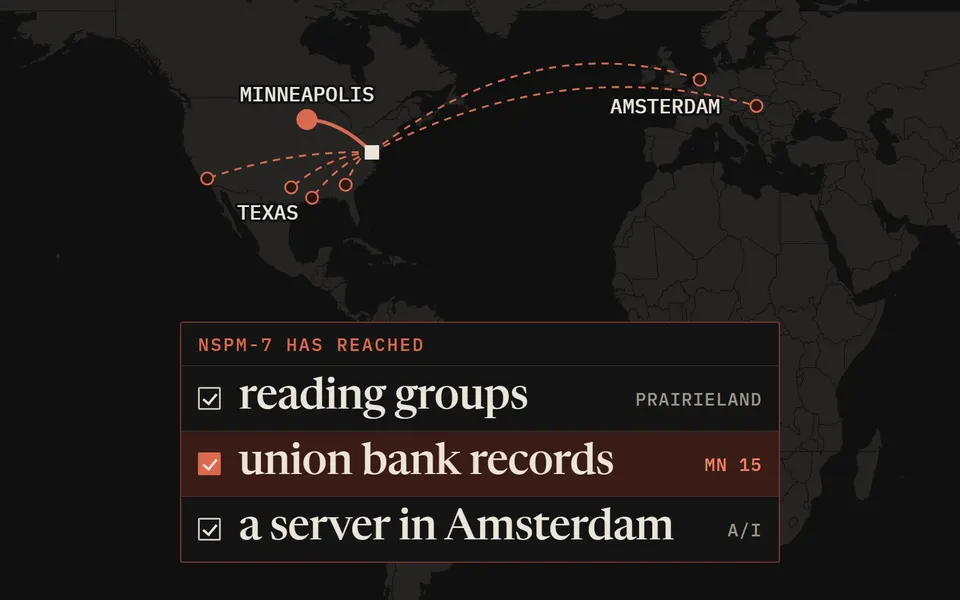
NSPM-7 has reached reading groups, union bank records and a server in Amsterdam. Minneapolis may be where it finds a limit.
On 7 October, in a footnote to an order about who may speak to whom, Judge Menendez wrote of the 15 people charged in Minneapolis: “As highlighted in the government’s Brief, none of the defendants are alleged to have used physical violence.”
The main count in the case, known as the MN 15, is conspiracy under 18 U.S.C. § 372, and the Eighth Circuit says prosecutors must prove an agreement to stop a federal officer “by force, intimidation or threat.” Prosecutors have said elsewhere that some defendants “hit or struck” officers but the question is live in the second most visible case tied to the presidential memo NSPM-7.
HSI, ICE’s investigative arm, says it opened the Minnesota investigation “in accordance with” that memo, signed in September 2025. Ten weeks after the signing, the Attorney General told task forces to “map the full network.” WIRED reported that about 120 HSI agents were assigned to Minnesota, at least 11 of them undercover. One went to public ICE Watch trainings and wrote that “there do not appear to be violations relating to 18 USC 111 or threats to public safety,” then joined a rapid response network by QR code and “continues to receive notifications.” Another watched a Hunter College panel and reported “no discussion of, or call for, violence towards law enforcement.”
Mapping a network carried the case well past the Whipple Building, where the blockades happened. The grand jury saw a slide headed “The Conspiracy” that drew in unions, teachers and a bicycle repair shop. HSI used customs summonses to demand bank-transfer records for SEIU and the Communications Workers of America, and the SEIU return included “strike payments” and “union member dues.” HSI’s report ends: “This financial investigation involving protest domestic terrorist financing continues.” The government says those records “played no role” in the indictment. It does argue that a defendant’s published CrimethInc. articles and a speaking tour should count as evidence somehow (a legal theory so novel even Emma Goldman herself was never convicted similarly). HSI’s Desmond Garcia told the grand jury that “no one is ever investigated or looked at or even researched on for First Amendment protected activities.”
In other cases the memo has had firmer ground under it, and the same logic has traveled further on it. Prairieland began with a police officer shot at an ICE facility in Texas, and 15 defendants were sentenced to more than 556 years. Prosecutors called a reading group the front name for “ANTIFA DFW,” though the FBI had closed its Antifa DFW inquiry in 2018 finding “No potential criminal violations.” Daniel Sanchez Estrada got 30 years, convicted of concealment for moving a box of zines and belongings, and of no terrorism charge. The Turtle Island plea papers describe IED discussions. Wierzbicki in Delaware faces a firearms charge, though the government’s own letter says his threats “existed solely online.”
Abroad, the reach does not need a jury at all. The US Treasury Department listed the Italian mail collective Autistici/Inventati on 26 August. Its payment and bank accounts went down, and 23 days later it dissolved, without a court hearing a word. Amsterdam police then seized one of its servers on a US request.
Minneapolis has none of what made the earlier cases easy for the DOJ. There is no shooting and no bomb plot. There is an organizing campaign, with meetings, Signal chats, shields and two blockades, and a government that says its a conspiracy. It is the furthest the NSPM-7 theory has gone legally. The indictment pleads hard blockades of “debris, vehicles, trailers, Czech hedgehogs, caltraps,” and shield lines meant “to physically resist.” Cameron Kennedy told an audience in April about “intentional shut them down blockades.”
The indictment names “Opposing the authority of the United States government” as a purpose and “Advocating and promoting direct action” as a method. Under Claiborne Hardware, a person cannot be held liable through association without “a specific intent to further those illegal aims.” One filing says Erik Davis “participated and moderated in-person planning and debriefing meetings.” Nothing in that filing puts Davis on a road with a barrier. Judge Menendez has also said it is “yet to be decided” whether the defendants’ steps to avoid surveillance hid a crime or were “a lawful response to what they perceived as government overreach against peaceful protesters.”
The DOJ has also already pulled back; in October the original indictment was superseded and cut from 94 pages to 62, with the label “Antifa” used half as often. Prosecutors have additionally dropped a conspiracy case in Los Angeles over face shields, and in Chicago they dropped what remained of the Broadview Six case after a judge read the unredacted grand jury transcript and said: “I have never seen the types of prosecutorial behavior before a grand jury.” The MN 15 defense holds part of one transcript but rulings on further disclosure are pending.
The Broadview charges ended without a ruling on the law. St. Paul has seen the same before. In 2009, with Brandon Darby’s convention cases still fresh, prosecutors dropped the terrorism counts against the RNC 8 and kept the felony conspiracy charges. Dropping the label cost them little at the time.
Any permanent limit to NSPM-7’s continued use as prosecutorial justification must come from a ruling. Motions are due on 18 December and a hearing is set for 8 January, with no trial date. The defense’s best facts, the NSPM-7 language and the reported order from Aakash Singh of the Justice Department to “go big,” run into Armstrong, which demands “clear evidence” of selective prosecution, and prosecutors answer that they “did not target and investigate the thousands of peaceful protesters.” In California, jurors acquitted two activists of a conspiracy count but still convicted them of stalking an ICE officer. A ruling on “force” would reach any blockade charged this way, in either direction; while a win on discovery could also go a long way to helping the defense, any ruling could further determine if the Attorney General’s map only stays useful by deciding if courts keep accepting that the existence of a social network is equivalent to a criminal conspiracy. Prosecutors have cut the Minnesota indictment to 200 overt acts. They still have to find “force” in them.