Germany’s New Spy Law Lets It Share Data on Minors With the US
Hamburg’s intelligence office has named the groups it says are behind the youth marches against conscription. From 31 December, a new law lets data on minors go to every NATO state on the terms that apply inside Germany.
Before the youth march of 20 November, Hamburg police went to the homes of about 14 people to warn them, according to Perspektive, a communist news site. Two days earlier the city’s office of the Verfassungsschutz, Germany’s domestic intelligence service, had published a notice saying the march had been mobilised “decisively” with the Internationale Jugend Hamburg, which it calls a substructure of the communist organisation Kommunistischer Aufbau.
Gen Z regelt (“Gen Z handles it”) and the pupils’ campaign Schulstreik gegen Wehrpflicht, a strike against the return of military service, marched together for the first time that day, under the slogan “fight together instead of shooting at each other”. Hamburg’s first notice, on 30 October, had named the mobilisers of the earlier march as including the autonomist groups OAT040 and Roter Aufbau, the Interventionistische Linke, and two groups it describes as “extremist groups with a foreign reference”, Young Struggle and Thawra. Neither notice alleges foreign money or direction.
The investigative outlet Correctiv found that the school strike’s website was registered by the federal board of the SDAJ, the youth organisation of the German Communist Party, at the party’s headquarters in Essen, and the SDAJ confirmed it. Die Vossische found that the Internationale Jugend posted a “#GenZ regelt!” call three days before the Gen Z regelt website was registered, and still concluded that funding or control by Kommunistischer Aufbau “is not proven”. The initiative’s named national organiser, Akram Selo, has told marchers not to mask up.
After the first Gen Z marches on 31 October, Frankfurt police reported 54 arrests and more than 100 injured officers, and Welt reported four children and more than 40 juveniles among the suspects in Leipzig and nationwide. Prosecutions for breach of the peace under sections 125 and 125a of the Criminal Code followed. Interior Minister Alexander Dobrindt blamed “violent left groups” and “migrant troublemakers”.
In Leipzig on 20 November, a march of about 2,500 passed off peacefully, according to the Leipziger Zeitung. Afterwards a group set off toward the Connewitz district, and police used a water cannon, then kettled a large group on Peterssteinweg, likely including minors, and took their identities. Police also removed about 40 occupiers from Leipzig University. Perspektive’s live blog reports about 40 people kettled in Nuremberg, a group held in an underground station in Cologne and every exit of the Karlsruhe rally closed. A pupil from Karlsruhe told the site that teachers and police locked pupils inside their school to stop them joining the strike.
A week earlier, on 13 November, the Bundestag passed a reform of both German intelligence services by 308 votes to 190. English coverage dwelt on the new powers to hack and sabotage abroad. The version adopted, drafted by the Interior Committee, also rewrites what the domestic service may share. Section 54(5) lets it pass data on minors to EU and NATO states on the same terms as transfers inside Germany. Section 43 lets it run joint data systems with foreign intelligence services, and only services from outside the EU and NATO need a “particularly” serious threat to join, which leaves American agencies in the ordinary tier. Transfers abroad are allowed to protect “the security of another state”. Junge Welt reports that the law also lets the service recruit minors as informants. The Bundesrat’s consent is not required, and the law takes effect on 31 December.
On 13 November 2025 the State Department designated a German group, Antifa Ost, as a terrorist organisation, along with an anarchist federation that began in Italy and two Greek groups. The National Counterterrorism Center’s own profile of Antifa Ost describes attacks in Germany and Budapest and no American member, attack or funding. In July Secretary of State Marco Rubio said militants “travel from across Europe and to the Americas to participate in each other’s attacks”, and the State Department began barring visas to anyone who shows “convergence” with groups of the far left.
On 9 and 10 November, three days before the vote, Germany’s Interior Ministry and the State Department hosted a workshop on far left terrorism in Berlin, with practitioners from 31 countries. The German government had told parliament in October that it had been preparing the event with the State Department and the Justice Department since the summer. Matthias Monroy, who reported the meeting, called it a secret event. It was the second such workshop; the first, in May, drew 14 countries, according to the Daily Wire. Hungary signed a memorandum with Washington on 29 October to exchange information on groups “such as Antifa Ost”, and its text is unpublished.
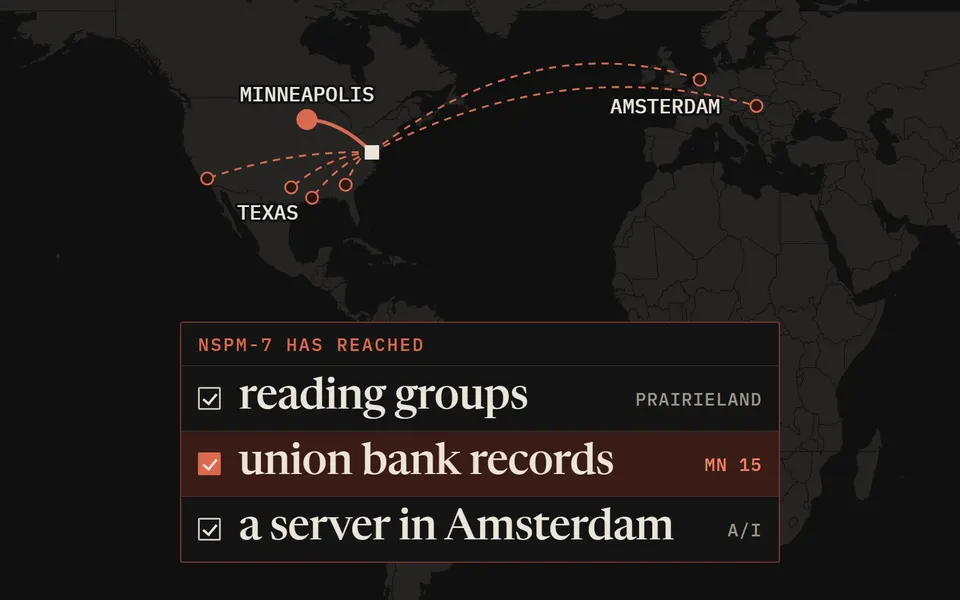
The Attorney General’s memorandum of December 2025, which carries out the presidential memo NSPM-7, tells the FBI’s Joint Terrorism Task Forces to “map the full network of culpable actors … inside and outside the United States”. A counterterrorism official told the Washington Post that a foreign link “can unlock certain investigative tools”. In Minneapolis, where Homeland Security Investigations opened its case against 15 activists under that memo, agents charted lines from 20 organisations to the defendants’ group. A German intelligence notice listing groups with “a foreign reference” is the kind of document such a chart can use.
At a meeting in The Hague, European officials told their American counterparts “we don’t see it quite the way you do”, and the Dutch government has called the US listing of the Italian collective Autistici/Inventati “unusual”. Germany cohosted the workshop, its intelligence office publishes the names of youth groups, and its parliament has written a clause for sending data on minors abroad.
The pupils who struck on 20 November were marching against being drafted into the army of a NATO state. From 31 December, whatever Germany’s domestic intelligence service holds on them can go to the intelligence services of every other one.