DSA and the Police
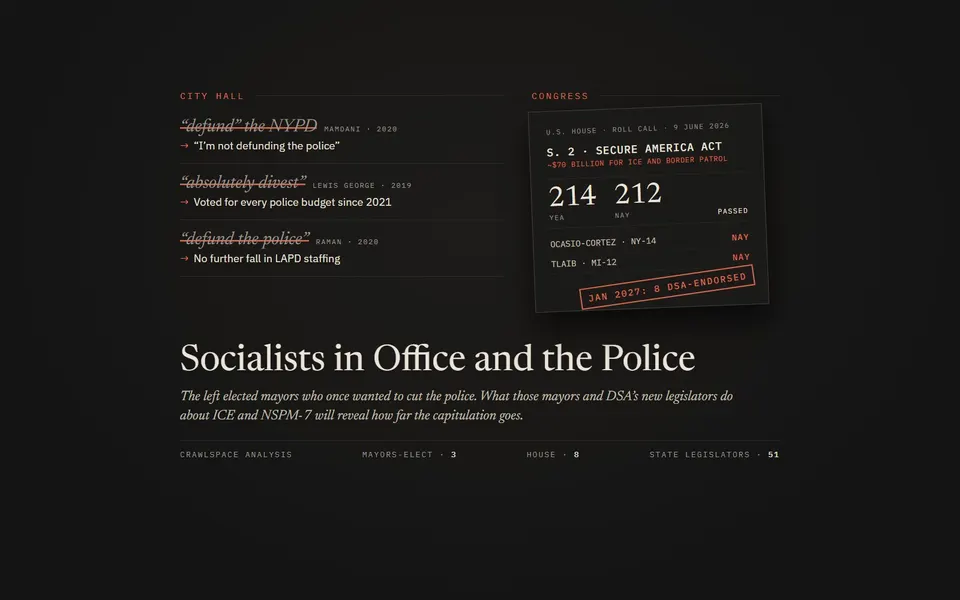
The left elected mayors who once wanted to cut the police. What those mayors and DSA’s new legislators do about ICE and NSPM-7 will reveal how far the capitulation goes.
On 27 January, about 100 protesters filled the lobby of a Tribeca Hilton Garden Inn where they said ICE agents were staying. Officers from the NYPD’s Strategic Response Group, the protest and counterterrorism unit Mayor Mamdani had promised to abolish, arrested 66 of them. Mamdani was four weeks into his term. His spokesperson praised the protesters for exercising their rights and the police for their response.
The American left has been here before. In June 1983 peace activists blocked the gate of the General Electric plant in Burlington, Vermont, that made Gatling guns. The socialist mayor opposed the blockade, and about 80 people were arrested. “He came and supervised the police arresting us,” organizer Robin Lloyd told the Washington Post. The mayor was Bernie Sanders. Murray Bookchin, who had helped elect him and previously considered Sanders a friend, later called him “a publicity man for GE.”
The pattern has held for every socialist who has won a big-city executive office since 2020. Each dropped “defund” before taking office and kept or hired a mainstream chief. Mamdani called the NYPD “wicked” and “corrupt” in 2020; by July 2025 he was saying “I’m not defunding the police,” and he apologized to officers that fall during the campaign. Janeese Lewis George, who takes over Washington D.C. in January, said in 2019 that she would “absolutely divest from MPD”; she has now voted for every police budget since 2021. Nithya Raman posted “defund the police” in 2020 and now does not want Los Angeles police staffing “to decline further.” David Morales in Providence will keep his force at its current size and keep its chief: “I believe stability is important.”
The break with the activist left, when it comes, will come over protests. Mamdani kept Commissioner Jessica Tisch, though a New York mayor can remove the commissioner at will. After an ICE agent shot a man in the Bronx in October, New York City DSA said Tisch “must get ICE out of New York and end NYPD complicity with these terrorists.” Seventeen democratic socialist officials and nominees signed a letter saying she must end police help for ICE operations and break up the SRG, “and if she won’t, she must be fired.” Mamdani said he had “no plans” to fire her.
Early in his term Mamdani also issued a directive, never published, requiring the NYPD to get City Hall’s permission before sending the SRG to make protest arrests. An NYPD spokesperson confirmed it to Politico after the unit arrested more than 100 people near the United Nations in September. One of them, Aber Kawas, was elected to the state Senate in November. Mamdani said he saw no justification for using the SRG there, though his office could have stopped the deployment. An abolitionist group told Politico: “This further confirms that regulating SRG deployments isn’t the solution.” On 12 November his office said it will disband the unit, replacing it with a civilian de-escalation team backed by officers who would “assemble nearby and could step in to conduct arrests if needed.”
In June Mayor Mamdani proposed 580 more officers. New York City DSA rebuked him publicly, and in July the final budget dropped the increase. Council Speaker Julie Menin said she was “deeply disappointed” by the “11th-hour decision.” On 9 June the House of the 119th Congress passed the Secure America Act, about $70 billion for ICE and Border Patrol, by 214 to 212. Alexandria Ocasio-Cortez and Rashida Tlaib, the two DSA-endorsed incumbents, voted no, as they did on every 2026 bill that funded ICE. Both signed the August letter urging the administration to “immediately withdraw” NSPM-7.
Past that point they split. Tlaib cosponsors Melt ICE, which would end immigration detention, as well as a moratorium on DHS surveillance technology and a ban on federal facial recognition. Ocasio-Cortez cosponsors none of them. In March Tlaib signed a letter asking the DHS Inspector General to investigate ICE’s warrantless purchases of Americans’ location data. Ocasio-Cortez did not, and she has given no public reason why. She sits on Energy and Commerce, the House committee for data brokers, which is the market ICE buys commercial surveillance data from.
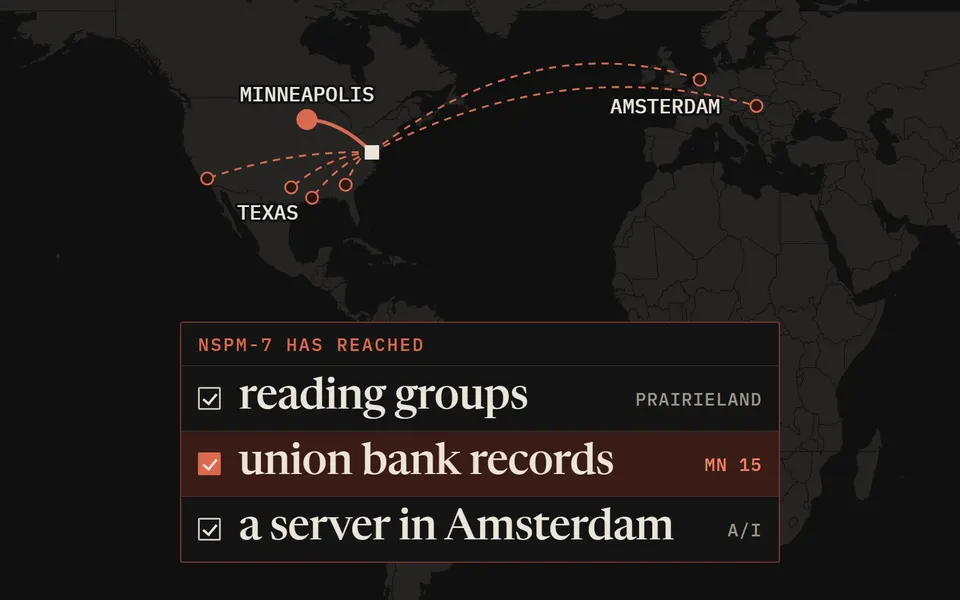
The letter named a product called Webloc. Its maker, PenLink, a US firm that acquired the Israeli company Cobwebs, is partly owned by the New York private equity firm Spire Capital and sells both Webloc and Tangles, a social media search tool. Citizen Lab reports that Webloc draws on data from up to 500 million mobile devices. An HSI sheet on one of the MN 15, the protesters charged in Minneapolis in a case HSI opened under NSPM-7, lists “PLX, WEBLOC” among the tools run against that defendant. ICE’s contract obligations to PenLink grew from $3.37 million in fiscal 2019 to $11.86 million in fiscal 2026. On 23 September ICE signed a $50 million sole-source vehicle for both products, running to 2031. Citizen Lab lists the Los Angeles police among Webloc’s customers. Raman takes office there in December.
Six more DSA-endorsed members join the House in January, when Democrats take control. Oversight’s incoming chair, Robert Garcia, answered the election with “Lawyer up,” and Tlaib sits on his committee. The defendants need records a committee can demand. In Minneapolis, HSI sent customs summonses, which need no judge, to the Fedwire and CHIPS payment systems for records of SEIU, the Communications Workers of America and the Sunrise Movement. In the Texas Prairieland case, prosecutors called a reading group the front for “Antifa DFW,” though the FBI closed its own inquiry into the group in 2018, recording “No potential criminal violations.” The committee can ask for that file.
In the statehouses, New York’s budget banned 287(g) agreements and masked officers and created a state right to sue federal agents, but its limits on sharing information with ICE apply to state and local employees “with the critical exception of police.” The full New York for All Act would have closed that gap. It had 76 sponsors in the 150-member Assembly and 32 in the 63-member Senate, including every DSA incumbent, and never left committee in either house. Governor Kathy Hochul wanted local police able to work with ICE in criminal matters. “We did not have three willing partners willing to go that far,” said its Senate sponsor, Andrew Gounardes. In Minnesota, after Operation Metro Surge, a 67–67 House stopped the bills that would have let people sue federal agents. In Vermont, a Democratic committee chair led the opposition to extending the state’s mask ban to ICE, arguing that no state can regulate federal officers.
NSPM-7 directs the FBI’s Joint Terrorism Task Forces to carry out its aims, and a city officer on one acts with an FBI agent’s powers. San Francisco’s police declined to renew in 2017, Portland voted to withdraw two years later, and Oakland ended its partnership in 2020 after reports showed task-force officers deployed to watch racial justice protests. No city led by a socialist has followed.
Mamdani has said nothing about the NYPD officers on the New York JTTF. The NYCLU wants to know how far it “can access the vast surveillance systems of the NYPD.”